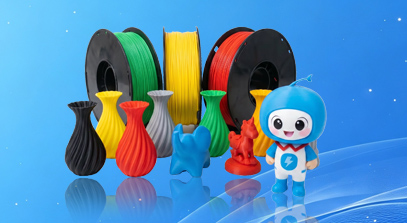
PLA is a bio-based material made from plant resources such as corn starch, biodegradable (compliant with RoHS/REACH), safe for use at home, school or office.
• Eco-friendly & Safe: PLA is a bio-based material made from plant resources such as corn starch, biodegradable (compliant with RoHS/REACH), safe for use at home, school or office.
• High-precision Extrusion: Diameter tolerance ≤±0.03mm, uniform material output, smooth printing without nozzle clogging.
• Low Shrinkage & Low Warpage: Optimized formula, strong interlayer bonding, no delamination or deformation of printed models.
• Rich Color Options: 30+ optional colors to meet creative needs and enhance the visual effect of printed works.
• Sealed Moisture-proof Packaging: Vacuum packaging + desiccant to keep the filament dry and in good condition for a long time.
Compatible Printers
Compatible with 99% of FDM/FFF desktop 3D printers.
| Category | PLA Basic | PLA Matte | PLA Silk | Test Method |
Vicat Softening Temperature | 57℃ | 62℃ | 56℃ | ISO 306, GB/T 1040 |
Heat Distortion Temperature | 54℃ | 57℃ | 50℃ | ISO 75, 0.45Mpa |
| Melt Flow Rate | 8.9g | 9.8g | 12.4g | 190℃/2.16kg |
Melting Temperature | 156℃ | 162℃ | 152℃ | DSC, 10℃/min |
| Tensile Strength | 28MPa | 18MPa | 14MPa | ISO 527, GB/T 1040 |
| Elongation (X-Y) | 10% | 10.6% | 3% | ISO 527, GB/T 1040 |
| Flexural Strength (X-Y) | 71MPa | 48MPa | 61MPa | ISO 178, GB/T 9341 |
| Flexural Modulus (X-Y) | 2590MPa | 2110MPa | 2220MPa | ISO 178, GB/T 9341 |
Impact Strength (X-Y) | 23.8kJ/m² 6.7kJ/m² (notched) | 16.2kJ/m² 4.9kJ/m² (notched) | 22.8kJ/m² 7.7kJ/m² (notched) | ISO 179, GB/T 1043 |
| Impact Strength (Z) | 12.9kJ/m² | 5.5kJ/m² | 16kJ/m² | ISO 179, GB/T 1043 |
| Water Absorption Rate | 0.43% | 0.4% | 0.5% | 25℃ 55%RH |
1.Pre-printing Preparation
• Drying Treatment: Store in sealed condition; dry at 55℃ for 6-8 hours if the filament is damp.
• Printer Inspection: Confirm no clogging in the nozzle to avoid impurities affecting material output.
2 .Filament Storage & Properties
The condition of filament directly affects the quality of 3D printed products, especially moisture-sensitive materials. Almost all filaments absorb moisture from the air during storage. During printing, high temperature in the nozzle rapidly vaporizes the moisture, causing melt expansion, flow rate fluctuation and micro-pores, which further lead to stringing, oozing, surface voids, rough texture or reduced strength. Generally, the higher the ambient humidity and the longer the exposure time, the more severe the filament moisture absorption, and the more obvious the printing defects. Therefore, before printing – especially for models with high appearance requirements – it is recommended to dry the filament first if its dryness cannot be confirmed. Meanwhile, keep the filament sealed and stored in a dry environment during use to maintain optimal printing performance.
PLA Basic 3D Printing Filament
Orange , White , Black , Brown , Apricot , Red , Light Blue , Yellow , Blue , Pink , Ice Blue , Grass Green
Light Gray , Purplem , Dark Gray , Green , Desert Yellow , Light Red